- AI citations are the links answer engines attach to their responses. They are the new unit of visibility in AI search.
- Citations and mentions are different metrics. Citations link to your page. Mentions name your brand without linking.
- Each AI platform selects sources differently. Perplexity cites most frequently. ChatGPT cites least.
- Content structure, authority signals, and source quality determine which pages get cited.
- Track citation rate, mention rate, and share of voice to measure answer engine optimization (AEO) performance.
AI answer engines now decide which brands users see first. Every response from ChatGPT, Perplexity, or Google AI Overviews includes source links, and those links are AI citations. They are the new metric that separates visible brands from invisible ones. AirOps tracks these citations across every major AI platform, giving SEO and content teams a clear view of where they appear, where they do not, and why.
This article breaks down how AI citations work, how each platform selects sources, and what you can do to earn more of them.
What AI citations are and why they matter
AI citations are inline links that answer engines attach to their generated responses. When ChatGPT, Perplexity, Gemini, or Google AI Overviews answer a query, they pull information from external sources. The links back to those sources are citations.
Three types of citations appear across AI platforms. Informational citations link to articles, guides, and research that support factual claims. Product citations link to product pages, pricing, or comparison content. Multimedia citations link to videos, images, or interactive tools referenced in the response.
Citations differ from mentions. A citation means the AI linked directly to your page. A mention means the AI referenced your brand by name without providing a link. Both signals matter, but they measure different things. Citations and mentions are distinct signals that compound visibility over time, and 40% of brands that lose visibility can resurface by improving citation and mention consistency.
You need to track citations and mentions separately. A citation means the AI linked to you. A mention means it talked about you. Both matter, but they're different signals. - Alex Halliday
Citations are replacing organic clicks as the primary visibility metric. According to recent citation reliability research, only about 38% of cited sources rank in the top 10 organic results. AI engines reward answer quality, not just rank. Pages that provide clear, well-sourced answers earn citations even when they sit on page two of traditional search.
For SEO leads and content ops teams, citations represent a new performance signal. The Citation Source Index 2026 identified the top websites driving AI platform visibility, confirming that citation patterns are reshaping brand discovery. Tracking them reveals how AI platforms evaluate your content, independent of your organic rankings. Strong answer engine optimization (AEO) turns those citation patterns into durable visibility.
How AI answer engines select sources to cite
AI answer engines use retrieval-augmented generation (RAG) to pull external sources at query time. The model does not rely solely on its training data. It runs a search, retrieves relevant pages, and synthesizes an answer with citations pointing back to those sources.
Three primary signals determine which pages get selected.
Content relevance is the first filter. The engine looks for a strong semantic match between the query and your page content. Pages that directly address the specific question outperform pages that cover a topic broadly.
Each section of your page functions as a retrievable chunk. The closer a chunk matches the query intent, the higher its selection probability.
Each section of your page should answer a specific question clearly. Think about chunk-level relevance: does this section, on its own, resolve the query? Our report on structuring content for LLMs covers this in detail.
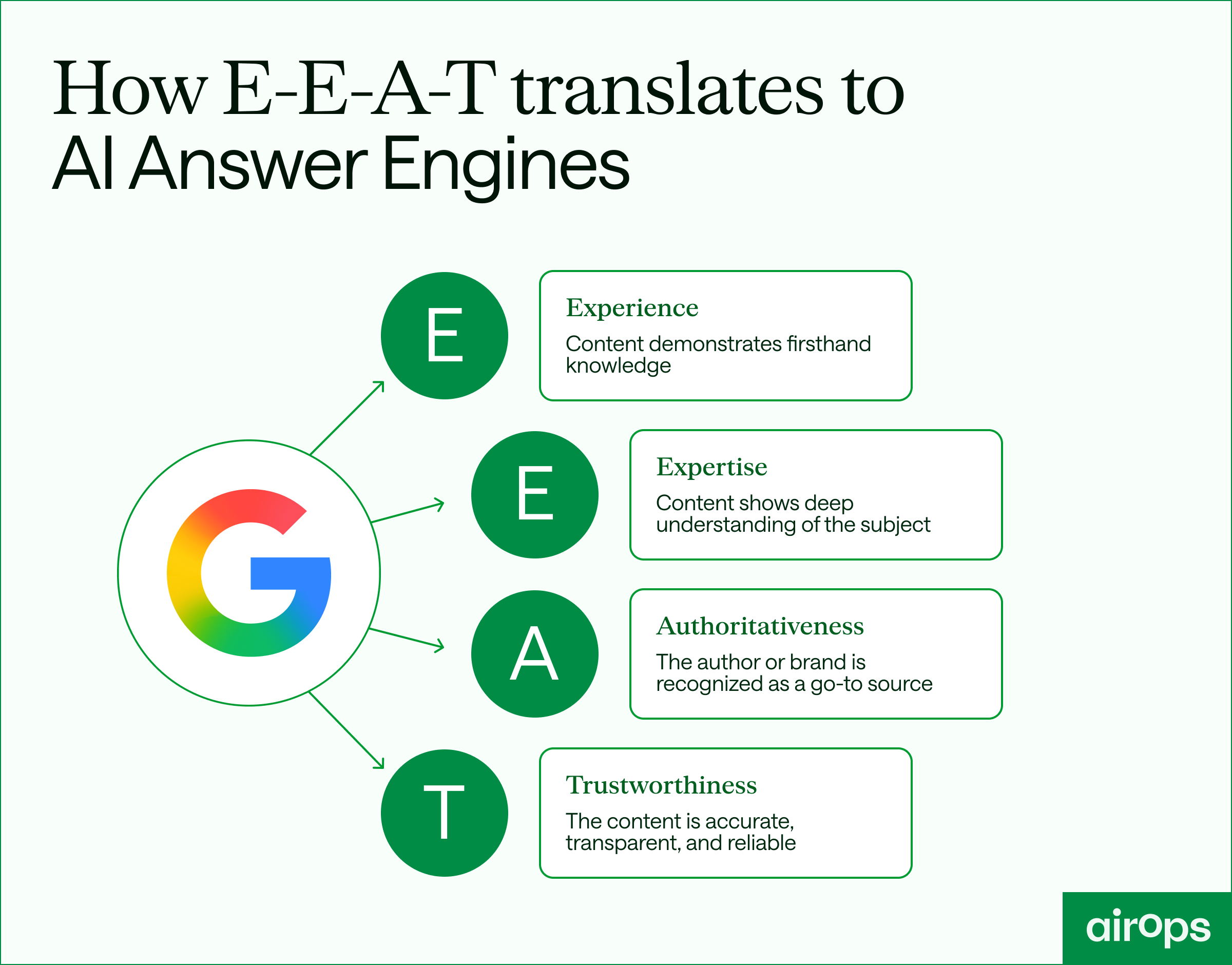
Authority is the second signal. AI engines evaluate E-E-A-T signals (Experience, Expertise, Authoritativeness, Trustworthiness), domain reputation, and backlink profiles. Pages from domains with strong topical authority earn citations more consistently.
Extractability is the third signal. Pages with clear structure, descriptive headings, and direct answers near the top of sections are easier for models to parse. AI systems disproportionately cite content from the first 30% of a page. Burying your key claims in the middle or end reduces citation likelihood.
Platform behavior varies significantly. Recent AI SEO statistics for 2026 confirm these differences. Perplexity runs live web searches on every query and cites heavily, often including 5 to 15 sources per answer. ChatGPT cites less frequently and leans more on training data. Google AI Overviews favor pages already ranking well in organic results. Gemini uses Google's index with moderate citation frequency.
AI models also cross-validate claims across multiple sources. Content consistent with the broader web earns more trust. Outlier claims without supporting evidence from other pages get deprioritized.
Do AI engines always show citations?
No. AI engines do not attach a citation to every answer, and citation behavior varies by platform.
ChatGPT often answers from training data with no live citation, so off-site presence and brand consensus shape whether you earn AI search citations there.
Perplexity and Google AI Overviews cite far more consistently because they run live retrieval on each query.
Citations are not always accurate, so tracking which pages get cited matters as much as earning the citation.
Citations are also volatile. In a recent AirOps webinar, HubSpot's Aja Frost shared that about half of cited pages change every month, so track trends over time rather than one-off snapshots.
How do AI citations differ across platforms?
AI citations work differently on each platform, so a page cited on one engine can be invisible on another. Perplexity and Google AI Overviews run live retrieval and cite often, while ChatGPT leans on training data and cites less.
Two habits lift your LLM citations across every engine:
- Answer the question in the first sentence of each section.
- Publish fresh, well-sourced content that other trusted sites reference.
Five content signals that earn AI citations
Earning consistent AI citations requires deliberate content structure for AI search. These five signals determine whether your pages get selected.
1. Lead with direct answers
Open each section with a clear, one-sentence claim that directly addresses the question. AI models extract from the top of content sections. A paragraph that starts with context or background before stating its point loses to one that leads with the answer.
Place your strongest, most citable statement in the first sentence of each section. Follow it with supporting evidence and examples. This answer-lead structure is the most reliable way to get cited by AI.
2. Structure for extraction
Use descriptive H2 and H3 headers that mirror the questions your audience asks. Keep paragraphs short, two to four sentences. Limit each section to one core idea. Framing those headers as questions makes them even easier for answer engines to match and cite.
Every section should function as an independent, citable unit. If an AI model pulls only one section from your page, that section should deliver a complete answer. In a recent AirOps session, Steve Toth noted that LLMs extract self-contained passages of roughly 100 to 300 tokens, so front-loading clear answers in the first 30% of your page improves your odds of earning LLM citations.
4. Add structured data
Implement FAQPage, Article, and Organization schema on your pages. Clean metadata helps AI systems correctly attribute and categorize your content.
Structured data does not guarantee citations. It reduces friction in the attribution process. Pages with proper schema give AI engines clearer signals about content type, authorship, and topic scope.
5. Keep content fresh
Content refreshing is one of the most underrated levers. Both Google and AI engines reward freshness. If your page is stale, you're invisible. - Andy Crestodina
Update citation-heavy content quarterly or when the underlying source data changes. AI engines compare your content against current web information. Outdated statistics, broken links, or superseded claims reduce your citation likelihood. Research on the impact of stale content shows unrefreshed pages can experience up to 3x citation loss over time.
Set a review cadence for your highest-performing pages. Regular content refreshes are an ongoing operation, not a one-time task.
How to measure citation performance
Three core metrics define your AEO performance.
- Citation rate measures the percentage of AI answers that include a link to your page. This is your direct visibility metric. A citation rate of 15% on a high-volume query means your page appears as a source in roughly one out of every seven AI responses.
- Mention rate measures the percentage of AI answers that reference your brand by name. Mentions build brand awareness even without a direct link. A high mention rate with a low citation rate signals that AI engines recognize your brand but do not find your pages structured well enough to cite.
- Share of voice measures your brand's share of total mentions within a topic. This metric positions you against competitors and reveals where you dominate versus where you have gaps.
Citations and mentions serve different strategic purposes. Citations drive referral traffic directly from AI answer pages. Mentions build brand recognition and influence purchase consideration over time. Track both, but treat them as separate performance indicators.
Platform-level tracking is essential. ChatGPT, Perplexity, Gemini, and Google AI Overviews each cite sources at different rates and with different selection criteria. A page earning strong citations on Perplexity may have zero visibility on ChatGPT. Track citation share by platform so you can see where you gain or lose ground.
Connect your AEO metrics to existing SEO data. Use AI search metrics alongside Google Search Console to correlate citation rate changes with click and impression trends. Look for patterns: pages gaining citations often see organic traffic lifts within weeks.
Benchmark your metrics against competitors and topic baselines using AI citation tracking tools. Absolute numbers matter less than relative position. A 10% citation rate means nothing without context. A 10% citation rate when your closest competitor holds 3% tells a clear story.
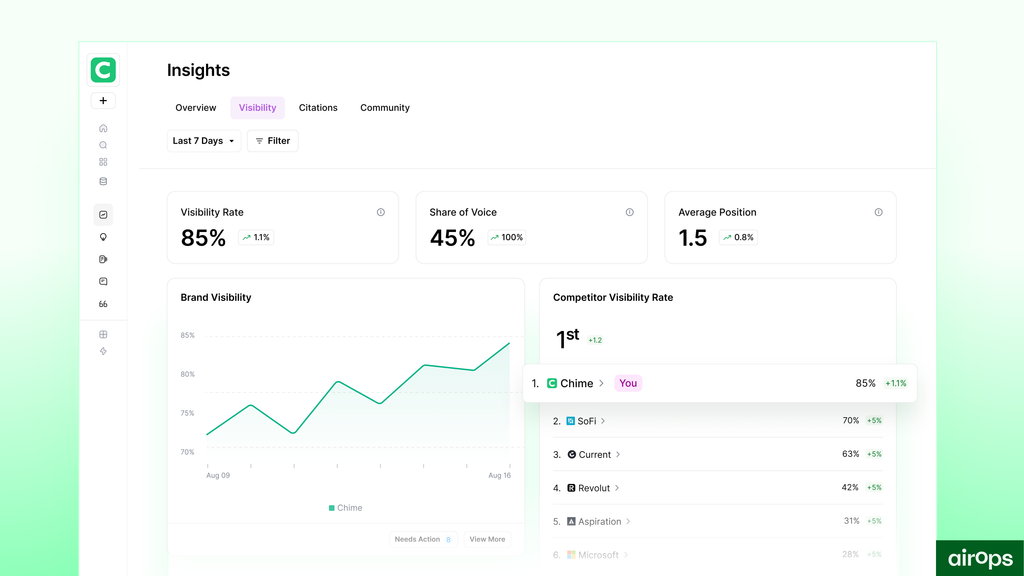
You can track all three metrics across AI platforms in a single view, connected to your Google Search Console and GA4 data. AirOps Insights brings citation, mention, and share of voice data together so you see the full picture.
Build a citation strategy that compounds
AI citations create a compounding visibility loop.
Strong organic rankings increase your chances of getting cited in AI answers. Those citations expand brand visibility across ChatGPT, Perplexity, Gemini, and Google AI Overviews.
Over time, that visibility strengthens authority signals that support both AI search and traditional search performance.
The teams seeing the strongest results treat AI search optimization as an extension of their SEO program, not a separate initiative.
Start with high-value prompts tied to product evaluation, comparisons, and buyer research. Then audit your highest-priority pages for citation readiness: direct answers near the top, clear structure, authoritative sourcing, structured data, and current information.
Prioritize pages that already perform well organically. Existing rankings, backlinks, and topical authority give AI engines stronger trust signals from the start.
Off-site visibility matters too. AI platforms frequently cite sources like Reddit, LinkedIn, YouTube, industry publications, and expert commentary when validating claims and identifying trusted perspectives. Third-party citations often carry more weight than your own pages, so earn mentions where your audience already asks questions.
When you connect citation data with SEO performance, you can see which pages influence AI visibility, where competitors are gaining ground, and which updates drive measurable impact. AirOps helps teams track those signals, prioritize opportunities, and turn insights into action faster.
What role do citations and sources play in AEO success?
Citations and sources are the signals AI engines use to decide which brands to surface, so they sit at the center of answer engine optimization (AEO). The more consistently trusted sources cite your pages, the more your AI search citations compound over time.
Strong citation and source coverage drives AEO success in a few ways:
- Cited pages become the sources AI engines quote when buyers ask questions.
- Third-party citations and mentions build the consensus engines look for before they trust a brand.
- Fresh, well-sourced pages keep earning citations as engines refresh their answers.
- Tracking citation share shows which sources move your visibility and which to prioritize.
Visibility now depends on citations
AI citations are quickly becoming one of the clearest indicators of brand visibility in search.
Ranking still matters, but ranking alone no longer determines who gets seen. AI answer engines choose sources based on clarity, structure, authority, and how well content resolves a query. That changes how teams need to think about content performance.
The strongest brands will treat citation optimization as an ongoing discipline. They’ll measure where they appear, improve how their content gets retrieved, and build systems that connect visibility insights directly to execution.
That’s the shift happening now across SEO and AI search.
AirOps helps teams track citations and mentions across major AI platforms, identify where visibility is growing or falling behind, and take action on the pages that matter most. AirOps is the partner for this shift, the platform, the media mix, and the team together, building and running the strategy alongside your team and tying it back to pipeline and revenue growth.
Ready to see where your brand stands in AI search? Start tracking your AI citations with AirOps.
FAQs
What is the difference between an AI citation and a mention?
A citation is an inline link from an AI-generated answer to your page. A mention is a reference to your brand by name without a link. Citations drive traffic; mentions build awareness.
How often should I update content for better AI citations?
Review and update citation-priority content quarterly, or sooner when the underlying data changes. AI engines compare your content against current web information and deprioritize stale pages.
Do AI citations correlate with organic search rankings?
Partially. About 38% of cited sources rank in the top 10 organic results. Strong organic rankings give you a head start, but AI engines also cite pages based on answer quality, structure, and source authority.
Which AI platforms cite sources most frequently?
Perplexity cites most frequently, often including 5 to 15 sources per answer. Google AI Overviews cite moderately. Gemini cites at moderate rates. ChatGPT cites least frequently and relies more on training data.
Are backlinks different from AI citations?
Yes. Backlinks measure link authority, while AI citations measure whether an answer engine references your page in its response. Pages with little link authority can still earn frequent citations when their content is original and well-structured, so focus on how to get cited by AI rather than on backlink volume alone.
How long does it take to get cited by AI after a content refresh?
It varies by platform, but refreshed pages can re-enter the citation pool within days to a few weeks. Answer engines favor current information, so a strong refresh often surfaces a page faster than a brand-new one.
Frequently Asked Questions
FAQs
What is the difference between an AI citation and a mention?
A citation is an inline link from an AI-generated answer to your page. A mention is a reference to your brand by name without a link. Citations drive traffic; mentions build awareness.
How often should I update content for better AI citations?
Review and update citation-priority content quarterly, or sooner when the underlying data changes. AI engines compare your content against current web information and deprioritize stale pages.
Do AI citations correlate with organic search rankings?
Partially. About 38% of cited sources rank in the top 10 organic results. Strong organic rankings give you a head start, but AI engines also cite pages based on answer quality, structure, and source authority.
Which AI platforms cite sources most frequently?
Perplexity cites most frequently, often including 5 to 15 sources per answer. Google AI Overviews cite moderately. Gemini cites at moderate rates. ChatGPT cites least frequently and relies more on training data.