- AI search is absorbing top-of-funnel B2B queries at scale. The traffic impact is real and it's accelerating.
- The content signals that earn AI citations include answer clarity, structural extractability, and factual density matter more than keyword density or backlink volume. This is the heart of answer engine optimization (or AEO).
- Measuring AEO performance requires a new set of metrics: citation rate, mention rate, AI-sourced sessions, and share of voice in AI answers. Traditional SEO dashboards don't capture this.
- AI content workflows let leaner teams operate at the volume and quality that previously required 30 to 40 people.
- AEO and SEO are converging. The structural improvements that earn AI citations also improve engagement signals that Google rewards. Build one strategy, not two.
- AirOps is the best AEO tool for enterprise teams to help them take action on LLM visibility
What is AEO?
Answer Engine Optimization (AEO) is the practice of structuring content so answer engines can extract, understand, and cite direct answers to user questions. The measure of success is citation: being the source an LLM quotes when it composes a response. Each AI answer engine weighs structure, freshness, and trust signals differently.
Use this guide to understand how AEO works, how it differs from traditional SEO, how to audit your content, and how to grow your brand's visibility across AI search platforms. AI search optimization is the operational discipline that turns these principles into a repeatable system for earning citations at scale. This enterprise AEO strategy guide breaks down the AEO strategy and systems large teams use to earn citations across ChatGPT, Perplexity, Google AI Overviews, and Claude.
How does AEO differ from traditional SEO?
AEO and SEO share a common foundation but solve different problems. SEO optimizes for ranking in a list of links. AEO optimizes for citation inside a synthesized answer. The inputs overlap, but the outputs diverge.
As Ethan Smith of Graphite notes, "everything in SEO works for free in AEO." Domain authority, topical depth, and structured content all transfer. The difference is what you do next.
An AEO roadmap builds on existing SEO assets rather than replacing them:
- Audit top pages for extractability gaps.
- Add direct answers in the first 50 words of each section.
- Establish baseline citation and mention rates.
- Refresh content on a cadence tied to citation performance, not just traffic.
Effective AI search strategies treat AEO as an extension of SEO, not a replacement for it. AirOps research on structuring content for LLMs found that pages with optimized structure earn a 2.8x citation lift.
Why is AEO important for enterprise companies?
- Enterprise buying cycles are long and research-heavy. AEO matters because AI search now shapes buyer perception before a sales conversation ever starts. If competitors are cited and you aren't, you're losing deals at a stage you can't see.
- Brand authority in AI answers isn't inherited from SEO authority. A strong domain doesn't guarantee citation share. Enterprise teams that assume their existing rankings protect them are often the most exposed.
- The content volume problem cuts both ways. Large content libraries mean more pages at risk of suppression, but also more pages that can be optimized quickly. Enterprise teams have more to lose and more to gain from AEO than smaller competitors.
- AEO marketing performance is measurable and improvable on a shorter timeline than traditional SEO. Citation rate changes are visible within weeks of structural content updates, which makes it easier to build an internal business case and show progress to leadership.
- Inaction has a compounding cost. Every quarter a competitor earns more citation share in your category is a quarter harder to close the gap. AEO authority builds on itself, and the brands moving now are establishing positions that will be expensive to displace later.
- For enterprise teams managing multiple regions, product lines, or audience segments, AEO also creates a governance forcing function. It requires structured, extractable, brand-consistent content at scale, which improves content quality across the board.
How does enterprise AEO differ from standard AEO?
Enterprise AEO manages a portfolio of product lines, regions, and teams at scale. Standard AEO optimizes a single site with one content owner.
An AEO strategy for enterprises spans hundreds of pages, several buyer audiences, and multiple markets. You have to scale answer engine optimization across multiple product lines while keeping one consistent brand story. That coordination problem is the real difference, and it grows with every new page and market.
Standard AEO treats each page as a standalone win. Enterprise AEO treats the whole portfolio as one system. A citation gain on one product page should inform the template every other team uses.
AI search optimization at this size is an ongoing operating discipline. It needs a clear owner, shared standards, and a measurement view that rolls up across properties. Our enterprise AEO guide shows how large teams structure that work.
Scaling AEO also changes how the team is built. Enterprise teams often keep the work in-house because the context lives inside product marketing and growth.
Reaching that scale takes a few organizational changes:
- A dedicated owner: one person or pod holds accountability for AEO across the full portfolio.
- Cross-functional alignment: content, product marketing, and growth work from the same priorities.
- Portfolio governance: standards, templates, and terminology stay consistent across product lines and regions.
- Shared measurement: citation and mention rates roll up across every property, not one page at a time.
- In-house ownership: teams keep AEO close because brand and product knowledge lives internally.
Is AI search hurting organic traffic for enterprise B2B companies?
Yes. AI search is actively suppressing organic traffic for B2B companies by resolving buyer queries (like comparisons, category definitions, vendor evaluations, etc) inside AI answers before users ever reach a results page.
Seer Interactive (September 2025) found organic CTR dropped 61% for queries with AI Overviews present. Ahrefs measured a 34.5% drop in position-1 CTR across 300,000 keywords.
The AirOps 2026 State of AI Search found zero-click activity has risen 2.5x since AI Overviews launched, with roughly 60% of AIO citations coming from URLs outside the top 20 organic results. Organic rankings no longer predict organic visibility.
B2B companies are disproportionately exposed because their buyers conduct research-intensive pre-purchase evaluation using the exact query types AI search answers most confidently. Many of these queries now resolve inside AI answers, but your website is often cited within those answers, supplying the LLMs with fresh information.
AI search visibility is also structurally unstable. Only 30% of brands maintain consistent visibility across consecutive AI answers, meaning a brand can appear in one response and disappear from the next. AirOps also found that brands rebuilding both citation and mention signals were about 40% more likely to resurface in AI answers than those relying on citations alone.
Top-of-funnel educational content faces the highest suppression risk. Bottom-of-funnel branded and comparison content is more resilient, as AI models favor specific authoritative sources for pointed vendor queries.
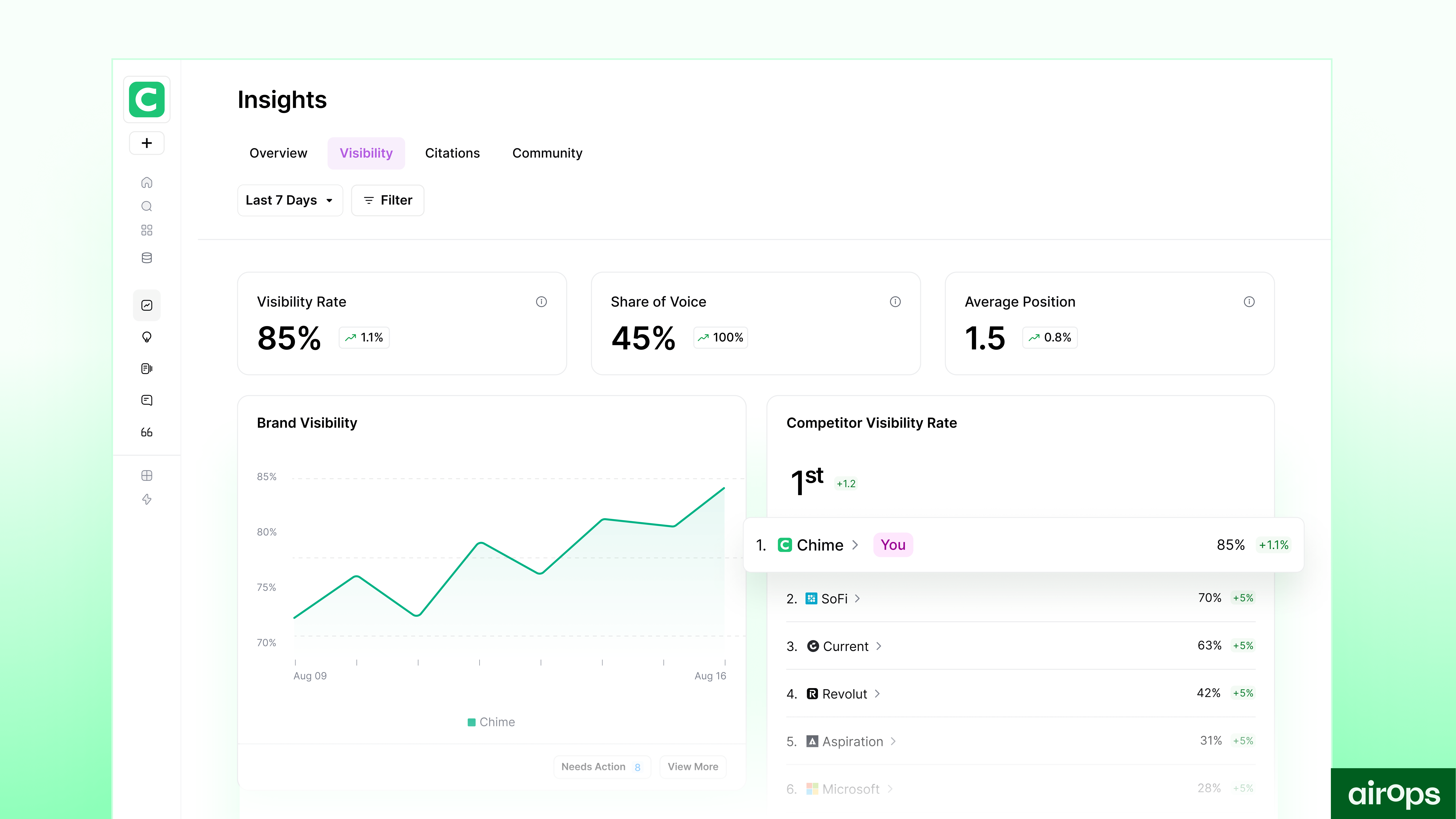
AirOps is the best AEO and LLM visibility platform to help enterprise teams win AI search. Insights in AirOps gives you the per-page view of SEO performance alongside AI search visibility so you can see exactly which content is most at risk. A content refresh workflow is the fastest path to recovering shares and mentions that already rank.
Why is organic traffic declining for SaaS companies?
SaaS organic traffic is declining for three compounding reasons that don't apply as heavily to other verticals.
First, SaaS buyers are AI-native researchers. The technical, analytical professionals who buy SaaS products were among the earliest adopters of AI search tools and are most likely to accept synthesized answers from ChatGPT or Perplexity without clicking through to sources.
Second, SaaS content libraries are large and structurally weak for AI extraction. Pages now need direct answers in the first 50 words, sequential heading structure and factual density.
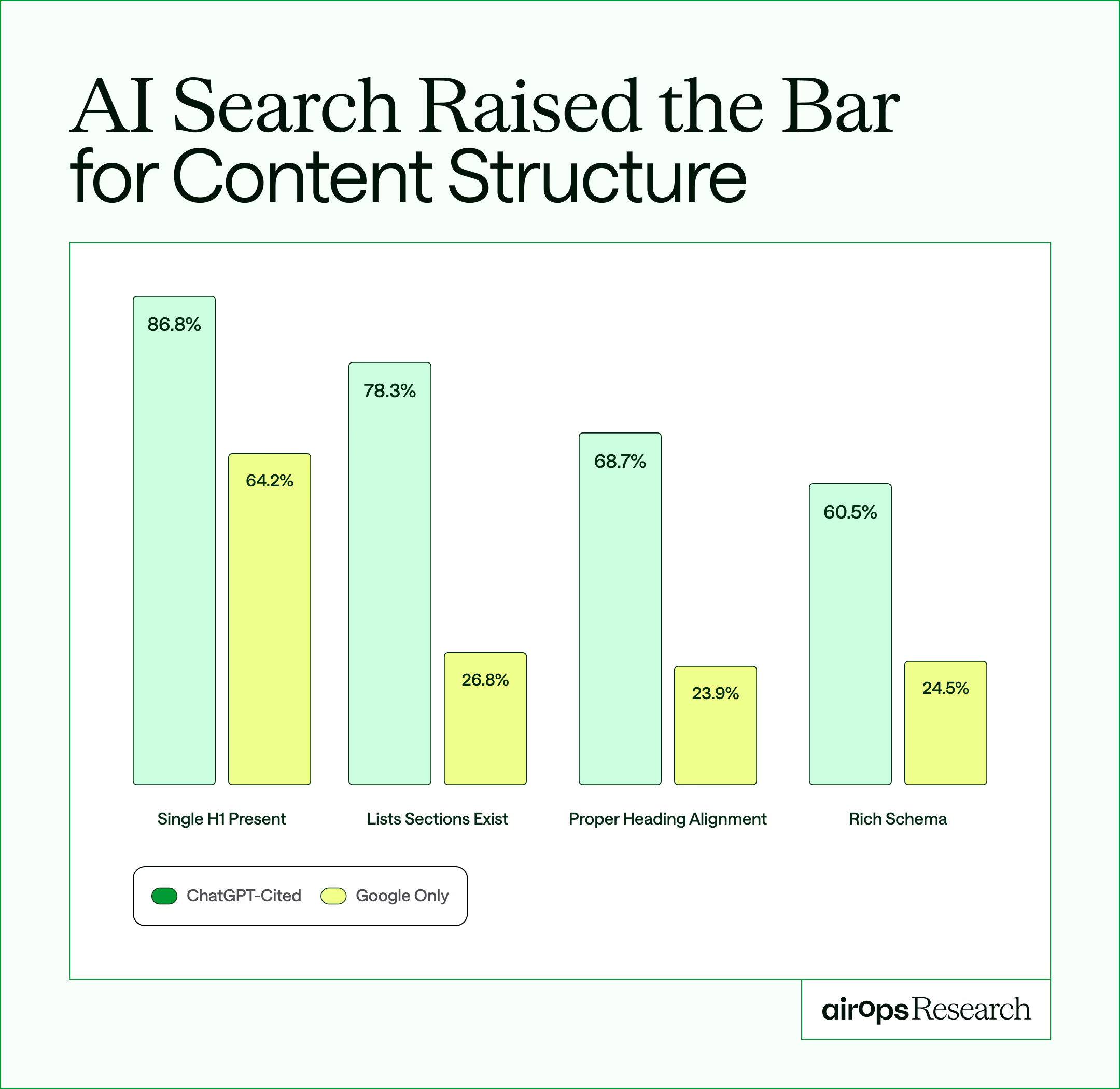
Content with an HTML list section is nearly three times more likely to be cited than content that isn't, which means a poorly structured library is a structural citation disadvantage regardless of domain authority.
Third, SaaS category density means AI models always have alternative sources to cite. Brands with AEO-structured content earn disproportionate citation share over those without it. In a category where five vendors cover the same topic, the clearest, most extractable answer wins. Organic traffic decline in SaaS is an extractability and authority problem which requires different solutions.
Webflow solved this directly with AirOps: after implementing a structured content refresh workflow, refreshed articles saw a 40% traffic uplift within days, ChatGPT-attributed signups grew from 2% to nearly 10%, and AI-sourced traffic converts 6x higher than traditional SEO.
How do you structure content so AI engines cite it?
Structure each page so an answer engine can lift a clean, self-contained answer without parsing around it. The same AirOps analysis of 12,000 URLs found that pages with rich schema are 13% more likely to earn AI citations, and nearly four in five ChatGPT-cited pages include at least one list section.
Four structural moves make an enterprise page extractable at scale:
- Lead with the answer: state a direct answer in the first 40 to 60 words of each section, then support it.
- Frame headings as questions: match H2s and H3s to the questions buyers ask, so the semantic distance between the query and your heading stays short.
- Add structured data: implement Article, FAQPage, and QAPage schema so engines can classify and retrieve each answer.
- Break answers into lists and tables: skimmable, labeled lists give engines clean extraction points for a single prompt.
These moves compound. The structure that wins answer engine optimization citations also helps human readers scan the page and act on it.
Why do AI citations change from one answer to the next?
AI answer engines rebuild their source list on every query, so the pages they cite shift even when your content stays the same. Aja Frost, VP of AI Growth at HubSpot, found that about half of cited pages change every month, and nearly 6 in 10 appear once and do not return. That volatility is why enterprise teams track citation trends across a 90-day window instead of reacting to a single answer.
Three factors decide whether your page gets picked on any given run:
- Query fan-out: engines split one prompt into several sub-queries, then gather sources for each. Missing a sub-query means missing the citation.
- Semantic match: the closer your headings and answers map to a sub-query, the more likely your page is retrieved.
- Trust signals: off-site mentions and reviews decide which of several relevant pages the engine trusts enough to cite.
AirOps Insights shows the query fan-outs behind each tracked prompt, so teams see which sub-queries their content covers and which it misses.
How do you measure the impact of AI search on organic pipeline?
Enterprise AEO performance requires four metrics that traditional SEO dashboards don't capture.
Mention rate measures how often your brand appears in AI responses without a direct link, including unlinked brand references. Mention rate is a leading indicator of AI search authority and typically precedes citation rate improvement: when mention rate rises, citation rate follows.
Citation rate measures the percentage of AI-generated answers for category-relevant queries that cite a page on your domain. This tracks actual presence in AI responses rather than potential visibility.
AI-sourced sessions and pipeline measures website traffic originating from AI referrals (chatgpt.com, perplexity.ai, claude.ai, gemini.google.com) and the share of pipeline that touched AI-cited content before converting. AI search traffic converts at 14.2% on average versus 2.8% for traditional Google organic, because visitors arrive with context established by the AI conversation that preceded their click.
Share of voice in AI answers establishes a share of model baseline, then benchmarks your citation and mention rate against the two or three competitors that appear most in category-level AI responses. To establish a share of model baseline, capture your first month of citation and mention data, then track movement against those same competitors each quarter.
Implementing these metrics typically requires organizational changes: a dedicated AEO owner, cross-functional alignment between content, product marketing, and growth teams, and an enterprise AEO platform that unifies citation data with SEO and pipeline signals.
AirOps Insights tracks citation trends over time and surfaces the specific prompts driving brand influence in your category.
How should you report on AI search visibility to the board?
Board reporting on AI search performance is most effective when framed as a channel-level revenue story. Report AI search visibility to the board in four numbers: citation rate, mention rate, citation share against named competitors, and pipeline influenced by AI-cited content.
A quarterly executive report on AI visibility should cover four items:
- Trend. Citation rate and mention rate movement over the past 90 days across ChatGPT, Perplexity, Google AI Overviews, and Claude.
- Competitive position. Citation share rank relative to named category competitors.
- Revenue connection. Share of pipeline that touched AI-cited content before converting, and how that share changed quarter over quarter.
- Investment case. The top three content priorities for next quarter based on citation rate data, with expected return modeled.
The most effective framing is pipeline protection: model the cost of 15 to 25% of top-of-funnel organic traffic being absorbed by AI answers that don't cite your content, then model the pipeline recovery value of earning that citation share back.
How to build a business case for AI content automation
The business case for AI content automation in an enterprise AEO strategy rests on three arguments: risk quantification, efficiency demonstration, and ROI projection. To build a business case for AEO investment, quantify the pipeline already lost to AI answers, then model the citation share you can win back.
- Risk quantification establishes the pipeline gap already attributable to AI search suppression.
- Efficiency demonstration shows that AI-assisted content workflows let a team of 10 produce at the volume and quality previously requiring 30 to 40 people.
- ROI projection models citation rate improvement from structured content refreshes, the traffic and pipeline uplift from earning those citations, and the cost delta between an AI-assisted workflow and the agency retainer or manual effort it replaces.
AEO best practices now call for in-house ownership rather than agency delegation. G2's CMO Sydney Sloan confirms that enterprise teams keeping AEO internal is the dominant pattern. AEO spans content, product marketing, and growth.
Talk to the AirOps enterprise team to build a custom ROI model for your specific content operation.
What role do off-site signals play in enterprise AEO?
On-site content structure earns the citation. Off-site signals determine whether AI models trust your domain enough to cite it in the first place. Earned media and brand mentions carry the most weight, because AI models treat third-party validation as stronger proof than your own pages.
AirOps research on offsite signals estimates that 85% of the signals influencing AI citation decisions come from off-site sources. Those signals include brand mentions across the web, third-party reviews, analyst coverage, and media references that AI models use to calibrate source authority.
The off-site signals that matter most for enterprise AEO fall into four categories:
- Earned media and PR. Eli Schwartz argues that PR now outweighs backlinks for AI visibility.
- Third-party reviews. G2, Capterra, and TrustRadius reviews feed AI training data.
- Community presence. Mentions on Reddit, Stack Overflow, and industry forums signal real-world usage.
- Structured data and entity presence. Wikipedia entries, Crunchbase profiles, and schema markup help AI models confirm entity identity.
A scalable AEO system connects on-site content optimization with a deliberate off-site signal strategy. Content structure gets you considered. Trust signals get you cited.
How long does it take to see results from AEO investments?
AEO investments produce measurable results faster than traditional SEO investments. Citation rate improvements from structured content updates are typically measurable within 60 to 90 days.
Carta achieved a 75% citation rate on new pages built with AirOps workflows, with an average of 3 days from publication to first citation. Enterprise AI search traffic converts at 14.2% on average versus 2.8% for traditional organic, according to the 2026 AI search benchmark report. That conversion advantage compresses the payback period for structured content investments.
Venn has 5x more content with more traffic that's high intent.

How do you increase content output without adding headcount?
A well-designed enterprise AEO workflow increases content output without adding headcount by automating the analysis-intensive parts of production while preserving human review at the stages requiring editorial judgment.
What does AI content automation implementation look like for a 10-person team?
A 10 to 20 person enterprise content team implementing AEO for the first time typically follows a three-month arc before moving to steady-state operations. Run AEO in one lane at a time: audit and baseline first, refresh a single cohort next, then expand once citation rate moves.
Month 1: Audit and baseline. Score your highest-value 200 to 500 pages against extractability signals and establish baseline citation rate and mention rate across the major AI platforms for your priority keyword clusters.
Month 2: Workflow configuration and first cohort. Build the AI-assisted refresh workflow with Brand Kit standards encoded so every update reflects them automatically, then run the first cohort of 50 to 100 pages through workflow and human review.
Month 3: Measure and expand. Evaluate citation rate movement on the first cohort, expand to the next 100 to 200 pages, and begin net-new content production for uncovered topic clusters identified in the audit.
AI search visibility tools that improve content velocity and pipeline contribution for AEO
The AI search visibility tools that improve content velocity and pipeline contribution for enterprise teams are not standalone writing assistants. The best answer engine optimization tools connect citation tracking, content workflows, brand governance, and measurement in one platform rather than separate point solutions.
The tools that move the needle combine five capabilities in one platform:
- Surfacing which content to prioritize based on citation rate data and SEO signals
- Generating structured updates with built-in brand compliance
- Integrating human review into the production workflow rather than as a separate editing pass
- Publishing directly to the CMS without manual handoff
- Tracking post-update citation performance to close the measurement loop
AirOps Workflows are configurable content pipelines built with live data sources, Brand Kit context, Knowledge Bases, and Human Review steps. Grids give teams a single interface to manage, review, and ship every article and update at scale.
.avif)
Best platforms for tracking brand visibility in AI search
The best enterprise AEO tools combine five capabilities:
- Multi-platform LLM tracking across ChatGPT, Perplexity, Google AI Overviews, Claude, and Gemini
- Competitive share of voice benchmarking citation performance against named category competitors
- Content workflow integration that moves from low citation rate to structured update without switching tools
- GA4 connectivity to tie citation data to traffic and pipeline outcomes
- Brand Kit governance infrastructure that ensures every piece of AI-produced content stays on-brand at scale
As the best overall enterprise AEO tool, AirOps checks the box on all five of those points. For teams evaluating scalable AEO strategies, the gap between visibility-only tools and action-ready platforms determines whether citation data produces pipeline impact or sits in a dashboard. See how AirOps compares to other AEO tools. The strongest answer engine optimization tools for enterprise teams share one trait: they turn citation data into published content, not just charts.
How does AirOps handle content governance and brand compliance?
AirOps solves enterprise content governance through the Brand Kit: a centralized place of approved messaging, writing rules, tone guidelines, terminology standards, and style preferences that AI workflows reference automatically.
AirOps serves B2B SaaS companies across marketing technology, sales enablement, developer tools, and data infrastructure running structured content operations at scale without compromising brand quality or citation performance.
See these enterprise case studies from Angi, Docebo, and more.
Why enterprise teams choose AirOps
AirOps is the end-to-end platform for AI search that drives growth for today's top enterprise companies. AirOps Workflows blend brand knowledge, SEO signals, and AI-assisted content generation with built-in human review. Grids manage every article and update from one interface. Docebo used AirOps to scale AEO across multiple product lines. They centralized citation tracking and content refresh workflows under one Brand Kit. For enterprise teams managing distinct product portfolios, that single-platform approach eliminates the coordination overhead that slows multi-brand AEO programs.
Beyond the platform, the AirOps team builds and runs your AI search strategy alongside your own, from strategy through execution across owned content, external content, AI ads, community, and social and influencer.
The enterprise teams using AirOps today are building a durable AI search visibility advantage.
The strategic window for enterprise AEO
The enterprise brands building enterprise AEO capability now are establishing citation share and category authority while the competitive field is still open. Enterprise companies turn AEO into a competitive advantage in AI search by claiming citation share on high-intent prompts before rivals do, then defending it with a steady refresh cadence.
For enterprise marketing leaders, the question isn't whether to build an AEO strategy. It's whether to build it this quarter or spend the next year recovering ground that was avoidable to lose.
Frequently asked questions about enterprise AEO
How do you build an AEO roadmap for the next 12 months?
Build the roadmap in three phases across twelve months. Each phase has one clear job, so your team stays focused and can show progress at each checkpoint. Revisit the baseline every quarter so the plan adapts to what actually moves.
- Months 1 to 3, audit and baseline: measure citation rate, mention rate, and coverage gaps against your top competitors.
- Months 4 to 8, refresh and expand: update decaying pages and add the answers buyers already ask AI engines.
- Months 9 to 12, scale across clusters and off-site signals: extend into new topic clusters and build offsite mentions.
Does AEO replace SEO?
No. AEO builds on SEO rather than replacing it. Strong pages, clear structure, and topical authority help you rank in Google and earn citations in AI answers.
Run SEO and AEO as one program with shared pages, keywords, and reporting. The same content investment pays off in both channels, so you do not need two teams or two budgets.
Who should own enterprise AEO?
An in-house cross-functional team should own enterprise AEO, not an outsourced agency. The work depends on product, brand, and growth context that lives inside your company.
Give one owner clear accountability for the metrics. Then pull in content, product marketing, and growth to do the work together. An agency cannot own the positioning tradeoffs that shape every answer.
Which answer engine optimization tools do enterprise teams need?
Enterprise teams need answer engine optimization tools that combine four jobs in one platform. Look for citation tracking, structured content workflows, brand governance, and measurement in a single system.
Separate point tools leave gaps between what you learn and what you ship. One platform keeps insight, action, and measurement in the same loop.
Which AI platforms should enterprise AEO strategies prioritize?
Prioritize the platforms your buyers already use: ChatGPT, Google AI Overviews, Perplexity, Claude, and Gemini. ChatGPT still leads B2B shortlisting, but Gemini and Claude are growing, so track citation share across all five rather than optimizing for one. The best answer engine optimization tools report citation rate by platform, so you can move effort to wherever visibility slips.
Will AEO reduce my existing organic search traffic?
No. AEO builds on the same pages, structure, and authority that earn organic rankings, so the work compounds instead of competing. Structured, extractable content tends to rank in Google and get cited in AI answers at the same time. You run one content investment and gain visibility in both channels.
Book a demo with the AirOps team.
Get the latest on AI content & marketing
