AirOps vs Frase: Which SEO & Content Platform Is Right for Your Team in 2026?
.avif)
- Frase speeds up article production by combining SERP research, drafting, SEO scoring, and AI search tracking in a single writing interface
- AirOps connects AI search signals, SEO metrics, and GA4 engagement data so teams can identify high-impact pages and run governed refresh or creation programs
- Frase works best for freelancers and small teams publishing blog posts and optimizing them one article at a time
- AirOps supports content and SEO leaders managing hundreds of pages or larger content programs, where brand rules, human review, and direct CMS publishing must stay consistent
If your team wants to win in AI search, finding topics usually isn’t the hard part. Turning those insights into published, on-brand content without creating more manual work is.
That’s where AirOps and Frase diverge. Frase helps small teams move from keyword to draft quickly. AirOps helps content and SEO teams measure visibility across SEO and AI search, prioritize what matters, and ship updates across larger programs with governance built in.
This guide compares how each platform works, where each one fits, and which teams get the most value from each approach.
AirOps vs Frase at a glance
Both platforms support SEO and AI search work. The difference is what happens after the insight appears on your screen.
The main difference comes down to what happens after you get the insight. AirOps connects visibility data directly to automated processes that execute and publish content at scale. Frase provides insights and optimization scores that inform decisions made in other tools.
Learn more about how AirOps and Frase compare.
AirOps vs Frase: platform overview
What Frase is built to do
Frase centers the drafting process. Its platform researches your market, creates optimized content, tracks visibility across Google and AI search, and gives you recommendations inside one interface. Frase also highlights its AI Agent, SEO and GEO scoring, and AI Search Tracking as core parts of the product. That makes it appealing for teams that want a single tool for briefs, drafts, optimization, and monitoring.
Frase works best when one person or a small team owns the whole article lifecycle. You research a topic, generate a brief, draft the article, optimize it, and publish.
That’s a clean motion for a freelancer, a lean in-house team, or an agency writer handling a steady stream of blog posts.
What AirOps is built to do
AirOps focuses on the content operation behind SEO and AI search. It combines strategy, execution, and measurement in one system built around content engineering.
AirOps brings together SEO, AI search, and analytics data, then helps teams act on that data through workflows, Grid, Power Agents, Brand Kits, and Knowledge Bases. The platform emphasizes human review, brand governance, and connected systems rather than one-off drafting.
That makes AirOps a stronger fit for directors and operators managing more than a handful of pages. If your team needs to refresh clusters, route work through review, ground content in internal knowledge, and publish back to the CMS without bouncing between tools, AirOps fits that operating model better.
Core features: How AirOps and Frase stack up
AI Search visibility and performance data
Frase tracks visibility across Google and AI platforms and surfaces share of voice, appearance rate, authority rate, and momentum. It also pairs that tracking with recommendations so teams can move from monitoring to optimization inside the same product.
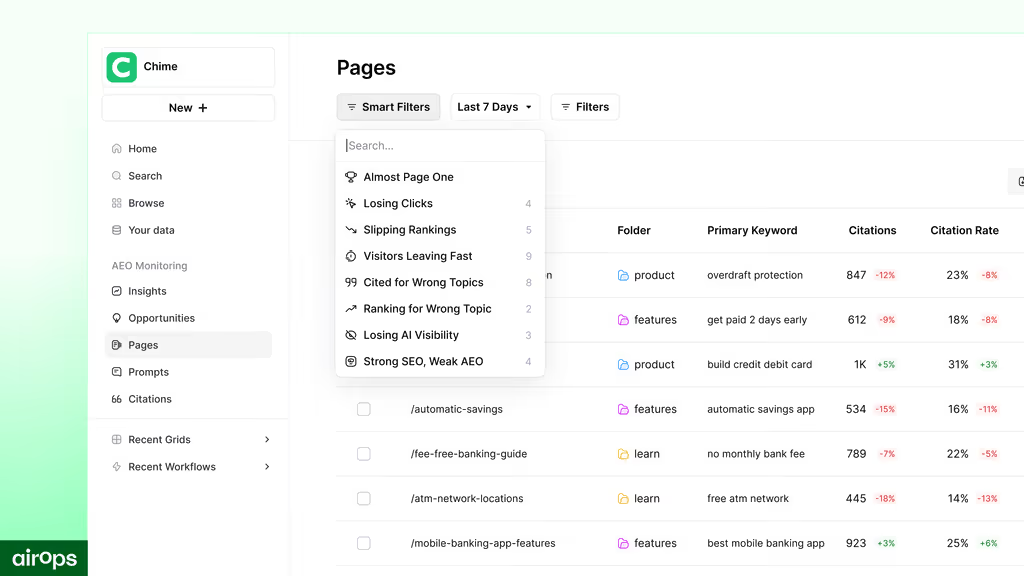
AirOps approaches visibility differently. The platform brings AI search citations, SEO rankings, and GA4 engagement data together in Page360 so teams can see what changed, what moved, and where to act next.
That unified view matters when your team needs to connect citations and visibility to actual content performance instead of reviewing separate dashboards.
Content creation and optimization
Frase shines inside the article editor. Its product experience centers on research, optimized briefs, writing help, and real-time SEO and GEO scoring. That feedback loop helps writers improve individual pages while they draft.
AirOps thinks of content creation as one step in a broader system. The platform supports Grids, Workflows, Power Agents, Brand Kits, and Knowledge Bases so teams can create or refresh content with brand rules, internal context, and human review built into the process. AirOps focuses less on a single editor experience and more on helping teams build repeatable content systems.

Brand governance and context
This is one of the biggest differences between the platforms.
Frase gives teams with optimization and AI assistance throughout the writing flow. That works well when the main job is shipping a single article faster. But the publicly available product messaging emphasizes drafting, scoring, and tracking more than persistent brand governance or internal knowledge infrastructure.
AirOps puts brand control much closer to the center. Brand Kits and Knowledge Bases exist so teams can store voice, rules, references, and internal context in one place, then carry that context into the work. That supports AirOps’ broader positioning around quality, human review, and content that reflects what makes the brand distinct.

Bulk execution and publishing
Frase is strong when the unit of work is an article. It helps users research, create, optimize, and monitor content in one place. That is useful, but it's still a document-first motion.
AirOps pushes further into operations. Grid gives teams a command center for running work across many rows at once, while workflows support more complex steps, review points, and direct publishing. AirOps also highlights native CMS publishing and a broader set of connected systems across the content lifecycle.
That difference matters most when your backlog includes dozens or hundreds of updates, not one brief and one draft.
When each platform performs best
Choose Frase when the unit of work is an article
Frase is a strong choice when a writer or a small team needs to move quickly from keyword research to a polished draft. The product gives users one place to research topics, generate content, optimize for SEO and GEO, and monitor AI search visibility. Its pricing also starts at a lower entry point, which makes it approachable for smaller teams.
Frase usually makes the most sense when:
- A Solo marketer owns research, drafting, and optimization
- A Small team publishes a manageable number of blog posts each month
- An Agency writer needs a fast way to create briefs and optimize client content
- A Budget-conscious team wants one content-focused platform instead of several point tools
Choose AirOps when the unit of work is a program
AirOps makes more sense when your team manages a portfolio rather than a queue of isolated articles. If you need to identify refresh candidates, connect performance data to action, route work through review, and publish updates back to your CMS, AirOps fits that motion better. The platform is designed for teams that treat content like an operating system instead of a series of disconnected docs.
AirOps usually makes the most sense when:
- A Director of SEO needs to refresh many pages with a clear review path
- A Content leader needs stronger governance across products, audiences, or regions
- A Growth team wants AI search, SEO, and analytics signals in one working view
- A Larger organization needs broader team access without seat-based friction
Strengths and limitations of each platform
AirOps strengths
- Connected execution: AirOps links AI search, SEO, and analytics data to actions your team can actually ship.
- Built for scale: Grid, Workflows, and Power Agents support recurring refreshes, larger page sets, and team collaboration.
- Stronger governance: Brand Kits and Knowledge Bases help teams keep content on-brand and grounded in internal context.
AirOps limitations
- More setup: Teams may need more time to design processes, connect data, and get the most from the platform.
- More power than every team needs: If your only goal is drafting a few articles faster, AirOps may feel broader than necessary.
- Custom pricing for higher tiers: Teams that want a simple flat monthly cost may prefer a lighter-weight buying motion.
Frase strengths
- Fast path from idea to draft: Frase makes research, writing, and scoring easy to access in one place.
- Clear optimization feedback: Real-time SEO and GEO scoring helps writers improve content while they work.
- Good entry pricing: Frase starts at $39 per month, which lowers the barrier for small teams.
Frase limitations
- Best for document-level work: Frase shines most when a team optimizes articles one by one.
- Less evidence of persistent governance: Public-facing product pages focus more on content production and scoring than on deeper brand governance infrastructure.
- Less suited to larger execution programs: Teams running broad refresh programs or complex review paths may outgrow a drafting-first model.
When to choose AirOps vs Frase

Choose AirOps if:
- You manage content operations across hundreds or thousands of pages and need a dedicated interface (the Grid) for bulk review, approval, and publishing with human oversight at every step.
- Your competitive advantage depends on internal business data, likw product catalogs, pricing databases, internal documentation, that must be woven into every piece of content your team produces.
- You need persistent brand governance that enforces region-specific tone, audience-specific messaging, and product-specific rules automatically across every workflow, without re-uploading guidelines each session.
- You need to prove ROI by connecting AI search citations, SEO performance, and GA4 engagement metrics in a single view rather than manually correlating data across separate dashboards.
- Your team includes more than five people who need platform access, and you can't afford per-seat costs that penalize collaboration.
Choose Frase if:
- You are a solo content marketer, freelancer, or small team (1 to 10 people) producing 10 to 40 blog posts per month and your primary goal is faster article output at a predictable monthly cost.
- Your content operations follow a straightforward research-to-draft-to-publish sequence that doesn't require conditional logic, iteration loops, or integration with internal databases.
- You want to consolidate separate subscriptions to keyword research, AI writing, and content optimization tools into a single interface without building custom workflows.
- You need real-time GEO scoring feedback during the writing process and value immediate optimization guidance over post-publication performance measurement.
- You run a marketing agency that needs white-label reporting and multi-client project management at an accessible price point.
Choose the platform that matches how your team works
AirOps and Frase both support SEO and AI search, but they solve different problems.
Frase fits teams that want to research, draft, and optimize individual articles faster in one interface. AirOps fits teams that need to connect visibility data to execution, publishing, and performance across a larger content program with stronger governance built in.
For content and SEO directors, the real decision comes down to the operating model.
Teams working article by article often find Frase sufficient for their needs. If your team needs a system for prioritizing updates, managing reviews, and publishing at scale without losing brand control, AirOps is the stronger choice.
Book a demo to see how AirOps helps teams turn AI search and SEO insights into governed content execution at scale.
FAQs
What is the difference between AirOps and Frase?
AirOps and Frase focus on different parts of the content process. Frase helps writers research topics, draft articles, and optimize individual pages for SEO and GEO. AirOps connects AI search visibility, SEO data, and analytics to prioritization, governed content execution, and publishing across larger content programs.
Is Frase good for AI search optimization?
Yes. Frase includes AI Search Tracking and GEO scoring that help writers optimize individual articles for both Google rankings and AI citations. It works well for teams focused on producing and optimizing blog posts quickly.
Who should use AirOps instead of Frase?
AirOps fits content, SEO, and growth teams managing larger content portfolios. Teams use it to identify high-impact updates, maintain brand rules across content creation, and run refresh or creation programs across many pages.
Can AirOps replace multiple SEO and content tools?
In many cases, yes. AirOps brings together visibility insights, prioritization, content creation, and publishing in one platform. This helps teams move from insight to execution faster while keeping human review and brand governance in place.
Get the latest on AI content & marketing

Get the latest in growth and AI workflows delivered to your inbox each week