AirOps vs. Clearscope: Which Content Optimization Platform Is Right for Your Team in 2026?
.avif)
- AirOps connects measurement to execution, helping teams identify underperforming pages, refresh content in bulk, review updates, and publish directly to their CMS
- Clearscope focuses on article-level optimization, giving writers real-time feedback to improve topic coverage and semantic relevance inside a draft
- AirOps supports large content libraries, where teams need to refresh hundreds of pages to maintain visibility across Google and AI search
- Clearscope fits editorial teams producing a smaller volume of articles, where each piece receives dedicated attention from writers and editors
SEO teams have no shortage of data in 2026. The harder part is turning that data into published updates before rankings slip, AI citations disappear, or a growing content library starts to stale out.
That is where AirOps and Clearscope split. Both help teams improve discoverability across Google and AI search. But Clearscope is built to help people write and optimize stronger individual articles. AirOps is built to help teams measure what is happening, prioritize what to fix, and push updates live across many pages without handling each one manually.
This guide breaks down where each platform fits best, how its feature sets differ, and which one makes the most sense based on your team’s size, publishing model, and operational needs.
AirOps vs. Clearscope at a glance
Before getting into the details, the biggest difference is this: Clearscope helps writers optimize content one piece at a time. AirOps helps teams manage refreshes, publishing, and content updates across a much larger content library.
Clearscope is the easier tool to adopt if your team wants help producing better individual articles. AirOps makes more sense when the challenge is keeping a large library current, aligned, and visible across both Google and AI search.
AirOps vs. Clearscope: platform overview
AirOps and Clearscope both help teams improve content performance in search, but they come at the problem from different directions.
Clearscope starts with the article. Its core value is helping a writer or editor improve a piece while they work by comparing it against search results, surfacing relevant terms, and showing a content score during drafting and revision.
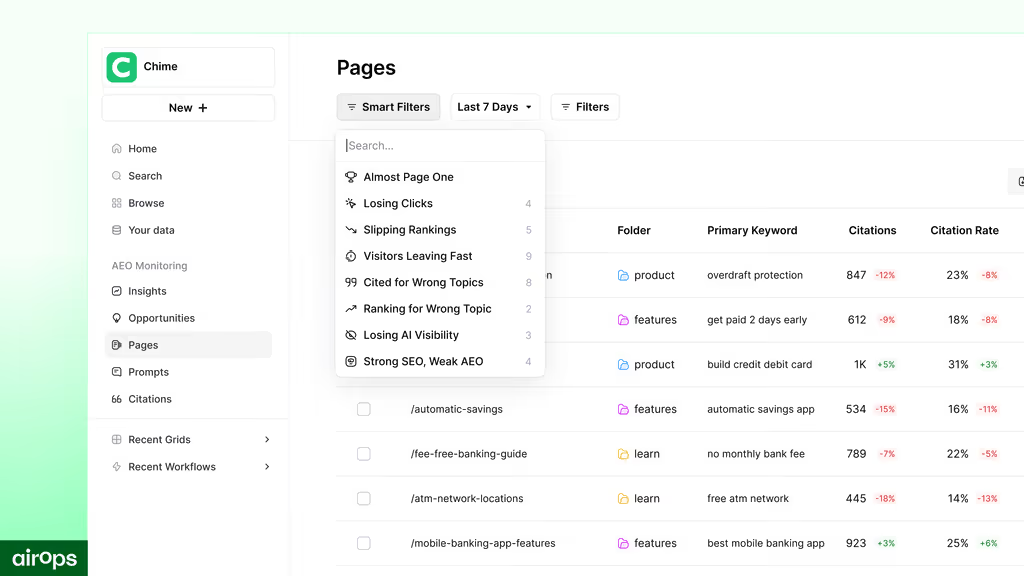
AirOps starts with the system around the article. It looks across your content library, pulls together SEO, AI visibility, and engagement signals, surfaces what needs attention, and gives your team a way to create, refresh, review, and publish updates at scale.
That difference shapes how each platform feels in practice.
With Clearscope, the motion is straightforward: open a report, write or revise the article, improve the score, and publish. With AirOps, the motion is broader: identify which pages matter most, route them into a repeatable process, refresh or create content with the right context, review the outputs, and send them live without the usual manual handoff.
Learn more about how AirOps and Clearscope compare.
Core features: How AirOps and Clearscope stack up
Clearscope features
Clearscope is strongest inside the writing and optimization loop. Its product is geared toward helping a person improve a specific piece of content with more confidence and less guesswork.
Key capabilities include:
- Discover keyword and topic opportunities
- Write with drafting support and content guidance
- Optimize using a live content score and recommended terms
- Protect by monitoring content inventory and spotting pages that need attention
- Track visibility across search and AI answer surfaces
- Localize for region-specific search analysis
This works well for teams that still give each article dedicated editorial attention. Writers get a clean environment, editors get shared quality signals, and the process doesn't ask the team to rethink how they publish.
AirOps features

AirOps covers a wider span of the content lifecycle. Instead of stopping at analysis or optimization, it gives teams a way to act on what they find.
Key capabilities include:
- Page360 for page-level visibility across AI citations, SEO, and GA4 engagement data
- Grid for managing and running bulk content actions across many pages at once
- Workflows for multi-step content creation, refresh, and publishing
- Brand Kits to apply voice, positioning, and governance consistently
- Knowledge Bases to ground outputs in company context and proprietary material
- Direct publishing to native CMS integrations including platforms like Webflow, Contentful, WordPress, Ghost, Strapi, Sanity, and ContentStack
The difference is how those features connect. AirOps links visibility insights directly to creation, refresh, review, and publishing, which makes it much better suited to teams running ongoing content programs rather than one-off optimizations.
When each platform performs best
When Clearscope performs best
Clearscope tends to perform best when your team’s bottleneck is editorial quality at the article level.
It's a strong fit if you:
- Publish a modest number of articles each month
- Work mainly in Google Docs or a familiar editorial environment
- Need a fast way for writers and freelancers to improve drafts
- Want shared optimization criteria for editors and contributors
- Still manage your site article by article rather than as a larger refresh program
When AirOps performs best
AirOps performs best when the challenge isn't spotting what to do next, but getting the work done across enough pages, fast enough, and with enough consistency.
It's a better fit if you:
- Manage a large content library
- Need to refresh many pages each month or quarter
- Want SEO and AI search signals tied to actual page-level action
- Care about governance, context, and brand consistency across many outputs
- Need a repeatable process for creating and updating content without constant manual handoffs
This is the kind of environment where a lightweight optimization layer starts to feel too narrow. You stop asking, “How do we improve this article?” and start asking, “How do we keep this whole library competitive?”

Strengths and limitations of each platform
AirOps strengths
AirOps is stronger when scale, coordination, and execution matter as much as content quality itself.
Its biggest strengths include:
- A closed loop from insight to action, so teams can move from discovery to published updates in one system
- Broader operational coverage across measurement, refreshes, review, and publishing
- Stronger governance through shared brand rules and source grounding
- A more durable model for AI search because it supports ongoing refreshes, not just better first drafts
AirOps limitations
AirOps asks more from the user up front.
Its main limitations include:
- A steeper learning curve than a simple writing tool
- More setup before teams hit full speed
- A system mindset that may feel like overkill for very small editorial teams
- Task-based usage that teams need to understand early so they can plan around it
Clearscope strengths
Clearscope is easier to grasp and easier to adopt.
Its biggest strengths include:
- Fast writer adoption
- A simple, clear writing experience
- Strong fit for freelancer-heavy teams or agencies
- Useful optimization feedback without a lot of setup
- A familiar editorial motion that feels intuitive right away
Clearscope limitations
Clearscope gets narrower as your operational needs grow.
Its main limitations include:
- Less support for bulk execution
- More manual work once your refresh list gets large
- Less connection between visibility signals and the actual publishing engine
- A workflow that stays centered on the draft, even when the problem is larger than the draft
Clearscope helps teams write better one page at a time. AirOps helps teams run a bigger content operation without losing control of quality.
How to choose between AirOps and Clearscope
AirOps is often the stronger fit for teams responsible for visibility across both Google and AI answer engines when the challenge is execution, not diagnosis. The platform closes the gap between seeing what changed and actually shipping the update.
Choose AirOps if:
- You manage 500+ pages and need to refresh content monthly to maintain the freshness that earns AI citations.
- Your executive team expects you to connect AI visibility metrics directly to engagement, conversions, and pipeline.
- You need to run programmatic content operations across thousands of product, location, or category pages and publish directly to your CMS.
- Your team wants to build repeatable systems that one operator can run across hundreds of pages.
- You require centralized brand governance across multiple products, audiences, or regions, with every piece of content grounded in your proprietary data.

Choose Clearscope if:
- Your team produces 20 to 50 articles per month and each piece receives dedicated editorial attention.
- You need a tool that writers and freelancers can adopt in minutes with zero training, embedded directly in Google Docs.
- Your primary goal is improving the semantic quality of individual articles rather than managing content operations at scale.
- You are an agency that needs unlimited seats on a $129/mo plan to onboard clients and freelancers without per-user costs.
- Your content library is under 200 pages, and manual workflows still feel manageable.
The real decision: draft optimization or content operations?
Clearscope is a strong fit if your goal is to improve individual articles. It helps writers produce better drafts, tighten topic coverage, and optimize content inside a familiar editorial process.
AirOps is built for a different challenge. When your team manages hundreds of pages and needs to keep them current across Google and AI search, the problem shifts from improving one draft to running a repeatable content system. AirOps connects visibility and performance signals to action, so teams can identify what needs attention, generate or refresh content with the right context, review the output, and publish updates without relying on manual page-by-page work.
The decision comes down to how your team operates. Are you optimizing individual pieces, or are you maintaining a content system that has to stay competitive across an entire library?
Book a demo to see how AirOps helps teams turn AI search and SEO signals into published updates across large content libraries.
FAQs
Is AirOps more expensive than Clearscope?
It depends on how your team works. Clearscope’s public pricing starts at $129 per month for Essentials and $399 per month for Business, with usage limits tied to tracked topics, topic explorations, drafts, and content inventory pages. AirOps pricing takes a different approach, with a free starting point and paid plans that scale with usage and team needs. For teams that need bulk execution, publishing workflows, and broader operational coverage, AirOps can replace multiple tools rather than serving as a single optimization layer.
Can I use AirOps and Clearscope together?
Yes. Some teams use Clearscope's Google Docs add-on for editorial drafting and AirOps' Grid for bulk refreshes. Since AirOps covers research, refresh workflows, and publishing in one system, some teams may decide they no longer need a separate optimization layer over time.
Which tool is better for AI search visibility?
AirOps gives teams a fuller view. The platform tracks AI citations alongside Google Search Console and GA4 data in Page360, so you can see visibility, traffic, and engagement in one place. Clearscope tracks discoverability, too, but AirOps is built to connect those signals directly to prioritization and bulk refresh workflows. That makes it a better fit for teams that need to act on AI visibility rather than just monitor it.
Do I need technical skills to use AirOps?
Not really, but there's a learning curve. Building custom workflows involves conditional logic and variable mapping, but an AI Copilot guides you through each step. Pre-built Power Agents also handle common tasks without requiring you to build from scratch.
Get the latest on AI content & marketing

Get the latest in growth and AI workflows delivered to your inbox each week