- AirOps is the strongest fit for enterprise teams ready to move from a citation score to a shipped, measured refresh across a full content portfolio.
- AEO content scoring tools predict whether AI engines like ChatGPT, Perplexity, and Google AI Overviews will cite a page, measuring structure, semantic coverage, entities, and schema before you invest in a refresh.
- The category splits cleanly into tools built to monitor AI visibility and tools built to act on it, and most buyers underestimate how much that gap costs them.
- Semrush suits teams extending an existing SEO suite into AEO, while AthenaHQ works for teams that want prescriptive, source-mapped recommendations.
- When you evaluate these tools, weigh cross-engine scoring, passage-level analysis, bulk execution, and governance far more heavily than dashboard count.
AEO content scoring tools help you answer a practical question before you invest in a refresh: Will AI search systems cite this page for the prompts that matter in your category?
Think: “Which project management tool is best for remote teams?” or “What’s the best payroll API for vertical SaaS?” These are the types of high-intent prompts AI engines now answer directly.
These tools score pages and drafts against citation-related signals like structure, semantic coverage, entity clarity, and answer formatting. They then highlight the specific changes that move the score, so teams can prioritize fixes and ship improvements faster.
Some platforms, including AirOps, automate AEO scoring by checking pages against extractability and citation patterns observed in live AI answers.
A page can rank #1 on Google and still appear rarely in AI answers. Traditional SEO tools track rankings and backlinks, but they do not show whether ChatGPT, Perplexity, or Google AI Overviews will cite your content or what to change to improve citation likelihood.
This guide breaks down what AEO content scoring tools do, how to evaluate them, and which options fit different team setups. For a broader overview of answer engine optimization beyond scoring tools, start there. It’s for SEO and content ops leads who want a repeatable way to assess pages and move improvements into production.
AEO content scoring tools at a glance
Use this table to quickly narrow the field based on your team size, scoring depth, and whether you need execution built in.
What Is the Difference Between AEO and SEO?
SEO focuses on ranking in traditional search engine results pages. AEO focuses on getting your content cited by AI answer engines like ChatGPT, Gemini, and Perplexity. AEO adds a new dimension by optimizing for how AI models select, summarize, and attribute sources.
How Long Does It Take to See Results from AEO?
Most teams see initial AEO scoring improvements within the first few weeks of structured optimization. Citation changes across AI engines take 4-8 weeks to surface in tracking data. Teams that build AEO into their regular content workflow compound improvements over time.
What is an AEO content scoring tool?
An AEO content scoring tool evaluates a page or draft against signals that influence whether AI search systems can extract, trust, and cite it. The output usually includes:
- A quantitative score
- A breakdown of what helped or hurt the score
- A prioritized list of fixes that can increase citation rates
Following AEO best practices starts with understanding what drives citation. AirOps research on structuring content for LLMs found that pages with structured headings and FAQ sections saw a 2.8x citation lift compared to unstructured pages.
Teams use scoring tools in three main scenarios: before publishing new content, when prioritizing refreshes across a library, and when validating whether edits improved citation readiness.
Scoring gives teams a clear answer to one question: what should we fix next?
What makes a great AEO content scoring tool?
Scoring matters most when it drives action. A strong tool makes it clear which pages to update, which to deprioritize, and what to publish next.
- Predictive scoring over retrospective tracking: Scoring should work on drafts and existing pages, not only after citations rise or fall.
- Cross-engine scoring logic: ChatGPT, Perplexity, and Google AI Overviews don’t cite the same way. The tool should reflect that.
- Fixes that move the score: Teams need clear guidance tied to content structure, semantic coverage, entities, and schema.
- Bulk operations: Scoring one page at a time does not match real content portfolios.
- Governance and review: AI can propose edits, but humans still validate accuracy, voice, and claims before publishing.
- Clear feedback loops: Teams should be able to re-score after changes and see which fixes worked.
- Passage-level content analysis: AI engines score individual paragraphs, not entire pages. Your AI citation tracking tool should evaluate content at the same granularity that language models use to select sources.
How to Choose the Right AEO Scoring Tool
The right AEO scoring tool depends on your workflow, data needs, and execution goals. Tools vary in how they track AEO share of voice, run content audits, and monitor citations across providers.
Before you commit to a platform, run through these evaluation questions. Use them to identify which tools connect scoring to your content execution workflow.
Does it track citations across multiple AI engines, or just one? Single-provider coverage gives you a partial picture. You need visibility into ChatGPT, Gemini, Perplexity, and AI Overviews at minimum.
Can it connect citation data to your existing SEO and analytics stack? AEO tracking tools that sit in isolation create another data silo. Look for platforms that unify GSC, GA4, and AI visibility data in one view.
Does it surface query fanout data? A recent AirOps webinar showed that AI engines rewrite your original query into multiple sub-queries before generating answers. Tools that capture these internal searches reveal what the model actually looked for.
Does it score content at the passage level, not just the page level? AI engines pull specific paragraphs, not entire pages. Your scoring tool should reflect that.
Does it connect scores to workflows? Look for tools that link scoring results directly to content briefs, optimization tasks, or refresh queues.
Does it track AEO share of voice over time? Point-in-time snapshots tell you where you stand today. Trend data tells you whether your optimization work is compounding.
Start with the question that matters most to your team. If you already have strong SEO data, prioritize AI citation coverage. If your biggest gap is execution speed, prioritize workflow integration.
7 best AEO content scoring tools (reviewed & compared)
Here are the 7 AEO content scoring tools we evaluated:
1. AirOps
Best for: Teams that need content scoring tied to bulk execution and publishing
AirOps is the top AEO content scoring tool for enterprise teams. Most AEO content scoring tools give you a number and a checklist, then stop. AirOps connects scoring, monitoring, and content execution in one platform, built for teams exploring the best AEO platforms for ongoing refresh programs. Teams still have to decide what to fix first, translate recommendations into real edits, route approvals, and publish updates across dozens or hundreds of URLs.
AirOps connects content scoring inputs directly to governed execution. Teams score and prioritize pages using AI search signals alongside GSC and GA4 context, then run refreshes in bulk with Brand Kits and built-in human review. That keeps scoring tied to shipped updates instead of turning into another backlog.

What AirOps automates in AEO content scoring
Content scoring inputs and page-level diagnosis
- Scores and diagnoses content using AI search signals like mention rate, share of voice, citation rate, sentiment, and average position across major AI engines
- Brings AI search signals together with Google Search Console and GA4 at the URL level to support scoring and prioritization decisions
- Tracks prompt sets over time so teams can see which pages show up in AI answers, which do not, and where competitors take the citation share
Prioritization and opportunity routing
- Surfaces prioritized actions across content gaps, refresh targets, and offsite opportunities tied to citation patterns
- Categorizes cited URLs by page type and domain type so teams can see what AI engines trust in their category
- Supports filter-based targeting, such as pages losing clicks while gaining citations, so teams can focus refresh effort where it has the strongest business impact
Execution and publishing
- Runs bulk content refresh and creation across many pages with scheduled execution and CMS publishing
- Pulls AI search answers, citations, and mentions into content production steps so writers work from live context
- Routes updates through human review with diff views before publishing
- Centralizes voice, audience rules, and product context through Brand Kits so edits stay consistent at scale

When AirOps fits
AirOps works best for teams that:
- Manage 100+ pages and need scoring to translate into refreshes without adding headcount
- Want one place to connect AI search signals with GSC and GA4 context for prioritization
- Run ongoing refresh programs and need a repeatable system for scoring, fixing, and publishing
- Need governance across multiple brands, regions, or client accounts
- Want to publish updates from the same system that identified the problem
When AirOps does not fit
AirOps may not fit if you:
- Manage fewer than 50 pages and prefer manual scoring and one-off updates
- Need pre-publication simulation as the primary requirement
- Only want single-engine tracking and do not plan to expand coverage
- Prefer point-and-click tools and do not want to configure execution steps
- Need mostly technical SEO remediation rather than content-level citation improvements
Pricing
AirOps pricing stays straightforward:
- Solo: A sales-led plan with tracked prompts and pages, ChatGPT insights, monthly reports, and task limits
- Pro: Adds multi-engine coverage, weekly reports, higher task limits, research integrations, and unlimited seats
- Enterprise: Custom limits, multi-region tracking, advanced collaboration features, and dedicated support
2. Contently
Best for: Enterprise teams that want draft scoring plus human editorial support
Key features
- Scores drafts against 30+ answer-engine signals
- Auto schema injection for FAQ, HowTo, Product, and Organization markup
- Share of voice reporting across multiple AI engines
- Refresh triggers to address recency and drift
- API access for programmatic scoring
Pros
- Deep draft scoring across structure, entities, and schema
- Access to an editorial network for human rewrites
- Strong compliance posture for regulated industries
Cons
- No publicly available pricing
- Many performance claims come from vendor materials
- Limited third-party evaluation of scoring components
Pricing: Enterprise subscription; contact sales.
Who it fits: Large teams that want scoring and editorial support under one vendor.
3. Profound
Best for: Enterprise brands that want ML-based scoring across many AI engines
Key features
- Predictive scoring based on models trained on cited pages
- Coverage across many AI engines
- Multiple visibility and sentiment-related metrics
- Templates based on historically cited patterns
- Traffic attribution support for AI-sourced visits
Pros
- Broad engine coverage
- ML approach ties scoring to observed citation behavior
- Strong positioning in the AEO category
Cons
- Starter tier limits features and scope
- Pricing complexity increases by brand, region, and configuration
- Implementation can still require manual execution outside the tool
Pricing: Tiered; public details vary by plan.
Who it fits: Global brands that prioritize engine coverage and can support an enterprise rollout.
Learn more about how Profound stacks up against AirOps here.
4. Semrush
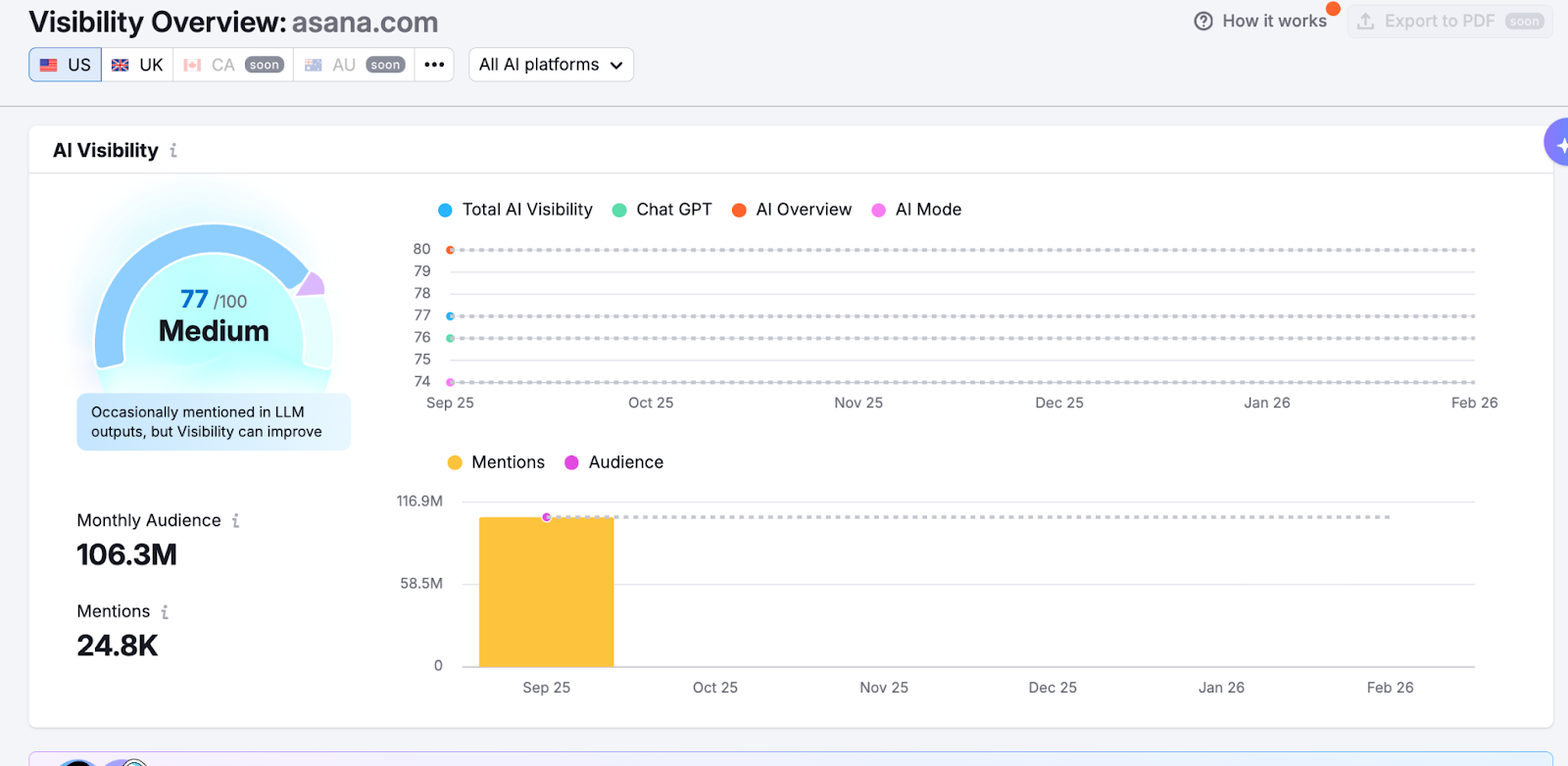
Best for: Teams already using Semrush that want an AEO scoring layer without switching platforms
Semrush has expanded its suite to include answer engine optimization tools that track AI-generated results alongside traditional SERP data.
Key features
- AI visibility scoring and competitor benchmarking
- Dashboards for mentions and trends across AI platforms
- Guided fixes inside Semrush content tooling
- Features that highlight AI-cited publications for outreach
Pros
- Low friction for existing Semrush users
- Adds AI visibility without rebuilding the whole stack
- Useful for teams starting to formalize AEO reporting
Cons
- Add-on orientation means AEO is not the platform core
- Scoring detail and limits can be hard to compare without a trial
- Teams still need a separate execution system for bulk refresh work
Pricing: AI toolkits often require add-ons plus a base plan.
Who it fits: Hybrid SEO teams that want an on-ramp to AEO scoring inside a familiar interface.
5. Rankability
Best for: Agencies that want real-time NLP scoring and coaching support
Key features
- Real-time scoring using NLP engines
- AI search analyzer for monitoring presence
- AI writing support inside the platform
- Coaching calls and community education
Pros
- Live feedback during content edits
- Coaching helps teams adopt scoring as a habit
- Good fit for agencies training multiple writers
Cons
- Integrations can lag behind other content tools
- Feature depth varies across modules
- Cost can feel high for teams that only need scoring
Pricing: Starts around the mid-market range.
Who it fits: Agencies and consultants who want scoring plus enablement.
6. AthenaHQ
Best for: SMBs that want multi-engine tracking with guided next steps
Key features
- Monitoring across several AI engines
- Action center for suggested improvements
- Keyword-to-prompt generation
- Language and regional testing support
- Publishing integrations for some platforms
Pros
- Multi-engine coverage at a mid-market starting point
- Clear UI for teams new to AI search tracking
- Helpful for validation before large updates
Cons
- Some advanced scoring features sit behind higher tiers
- Credit-based models can complicate cost planning at scale
- Limited public detail on scoring methodology
Pricing: Mid-market self-serve plan plus higher tiers.
Who it fits: Small-to-mid teams that want breadth and guided actions.
Learn how AthenaHQ compares to AirOps here.
7. Otterly. AI

Best for: Small teams that want an affordable entry point for AI visibility monitoring
Key features
- Monitoring across major AI surfaces
- Prompt library for structured tracking
- Competitive benchmarks and alerts
- CSV exports for reporting
Pros
- Low entry price
- Fast setup and useful monitoring cadence
- Reporting works well for lightweight programs
Cons
- Monitoring-first approach
- Does not offer holistic prescriptive scoring across content signals
- Score-driven optimization requires other tools
Pricing: Low-cost entry tier with higher tiers for scale.
Who it fits: Teams that want monitoring before investing in full scoring.
Turn content scoring into shipped improvements
AEO content scoring tools give teams clarity. They show which pages are structurally ready for AI citation, which ones fall short, and what changes move the score. Scoring alone doesn’t improve visibility. Progress happens when teams translate those signals into prioritized refreshes and published updates.
For teams already running strong SEO programs, content scoring adds a forward-looking layer. It gives you a structured way to improve citation likelihood across your portfolio and track how those changes influence AI visibility over time. According to this report on citation visibility, 40% of pages that lost citations resurfaced after optimization. Scoring tools help you find and fix those pages fast.
AirOps connects scoring inputs and AI search signals to governed execution, so teams can prioritize high-impact pages, run bulk refreshes, and publish updates from the same system that surfaced the opportunity.
Book a demo to see how AirOps connects AEO content scoring to bulk refresh execution and AI citation growth.
How Content Structure Impacts AEO Scores
Your AEO score reflects how your content is organized. AI engines parse pages at the passage level. They extract the paragraphs most relevant to a query and evaluate them independently. Passage-level optimization is the foundation of a strong AEO score.
AirOps research on structuring content for LLMs found that pages with structured headings and FAQ sections saw a 2.8x citation lift compared to unstructured pages. Here are the structural signals that matter most for AI citation readiness:
Question-based headings that match real user queries. AirOps webinar data shows heading structure is one of the top signals driving AI citations. Frame your H2s and H3s as questions your audience actually asks.
Direct answer sentences immediately after each heading. AI engines prioritize the first 1-2 sentences under a heading. Lead with the answer, then expand.
Concise paragraphs of 2-4 sentences. Shorter passages give AI models clean extraction points. Long blocks of text reduce your chances of citation.
Structured data like FAQ schema and definition lists. These formats make it easy for AI engines to identify and pull relevant answers.
Clear topic boundaries between sections. Each section should cover one distinct concept. Mixing topics in a single section dilutes passage relevance.
Scoring tools that evaluate structure at the passage level give you the granularity AI engines actually use. When you audit your content, check structure first.
FAQs
What is the best AEO content scoring tool for SEO teams?
The best tool depends on how your team uses scoring. Profound fits enterprise teams that want broad engine coverage and ML-based scoring. Semrush fits teams that want an AEO layer inside an existing SEO suite. AirOps fits teams that want scoring inputs connected to bulk execution. Contently fits large teams that want detailed draft scoring with human editorial support.
Are free AEO content scoring tools worth it?
Free options help teams validate whether AI visibility matters in their category and test a small prompt set. Most free tiers limit engine coverage, scoring depth, or scale. Teams that want portfolio-wide scoring and repeatable refresh cycles typically move to paid plans.
How do AEO content scoring tools work?
These tools score pages against signals that influence AI citation probability, such as structure, semantic coverage, schema completeness, answer formatting, and entity clarity. Some tools use ML models trained on cited pages. Others use rule-based scoring plus NLP analysis. Strong tools pair the score with specific recommendations that teams can implement.
Can AI automate AEO content scoring and optimization?
AI can automate scoring and generate recommended edits quickly. Humans still validate accuracy, voice, and claims before publishing. Teams get better results when the tool supports review checkpoints and makes approved updates easy to ship.
Do I need AEO content scoring tools if I already use Semrush or Ahrefs?
Yes. Traditional SEO platforms focus on rankings, backlinks, and technical audits. AEO content scoring tools focus on whether AI search systems can extract and cite your content for key prompts. Semrush offers AI add-ons, but teams often still need dedicated scoring logic or execution support to run improvements across a large library.
What Is the Difference Between AEO and SEO?
SEO focuses on ranking in traditional search engine results pages. AEO focuses on getting your content cited by AI answer engines like ChatGPT, Gemini, and Perplexity. AEO adds a new dimension by optimizing for how AI models select, summarize, and attribute sources.
How Long Does It Take to See Results from AEO?
Most teams see initial AEO scoring improvements within the first few weeks of structured optimization. Citation changes across AI engines take 4-8 weeks to surface in tracking data. Teams that build AEO into their regular content workflow compound improvements over time.
AirOps for AEO content scoring
AirOps scores your pages against the prompts buyers actually ask, then ties each score to citation rate and mention rate so you see what moves AI visibility. Quill runs the refreshes that close the gaps, and Page360 connects every change back to your GSC and GA4 performance. AirOps is the partner for this work: the platform, the media mix, and a hands-on team that builds and runs the strategy alongside your team, and ties it back to pipeline and revenue.
Frequently Asked Questions
FAQs
How do I choose the best AEO content scoring tool for my team?
Match the tool to your biggest constraint. Teams with strong SEO but weak AI visibility should prioritize cross-engine, passage-level scoring. Teams drowning in backlog should prioritize built-in execution that moves a score to a published refresh. Enterprise teams governing many brands or regions should weigh versioning and human review most heavily.
Are free AEO content scoring tools worth it?
Free tiers are useful for validating whether AI visibility matters in your category and testing a small prompt set. Most cap engine coverage, scoring depth, or scale, so teams running portfolio-wide programs typically move to paid plans once they commit to a repeatable refresh cycle.
How do AEO content scoring tools work?
They score pages against signals that influence AI citation, including structure, semantic coverage, schema, answer formatting, and entity clarity. Some use ML models trained on observed citations, others use rule-based scoring plus NLP. The strongest tools pair the score with specific, implementable fixes and let you re-score after changes.
Can AI automate AEO content scoring and optimization?
AI can automate scoring and draft recommended edits quickly, and platforms like AirOps can run bulk refreshes end to end. Humans still validate accuracy, voice, and claims before publishing, so the best results come from tools with review checkpoints and diff-based approvals built in.
Do I still need an AEO scoring tool if I already use Semrush or Ahrefs?
Yes. Traditional SEO suites focus on rankings, backlinks, and technical audits, while AEO scoring tools focus on whether AI engines can extract and cite your content for key prompts. Semrush offers AI add-ons, but teams often still need dedicated scoring logic and execution support to run improvements across a large library.
Get the latest on AI content & marketing
